The Forest Resources of this planet has been depleting at a very fast rate due to ever growing demand of wood and wood based products especially from the developed countries. And, in the process the entire ecological equilibrium has been disturbed leading to vanishing of flora and fauna, and the like. Despite the best efforts from the world community, the demand of the wood based products is simply not declining but is on the rise leading to illegal felling of trees, smuggling of wood, etc. This is presently leading to a disaster in the entire world.
There has been focus on alternatives to wood and a lot of composites including plastics have come up but all these have their own restrictions in usability towards complete replacement of wood. However, of late bamboo has been gaining focus as a viable replacement of wood to some extent because of its quick regeneration i.e. within four to six years.
As far as our country is concerned, the statistics of the year 2000 shows that in that year our total wood consumption was 60 million cu. m. Of this, 20 million cu. m. were imported worth at least Rs. 10,000 crore. To meet the demand Government has put wood import under OG L. The demand of wood in our country is rising at 10 per cent per annum. Most of the wood requirement of the country is converted into Plywood and in sawn timber for construction and agriculture articles.
Wood Industry in the North Eastern Region
In the North Eastern Region, due to availability of prime quality timbers, wood-based industry had an early entry and healthy growth in this part of the country. Manufacturing activities of plywood started in this region as early as 1916. Although the industry suffered a setback initially, it started flourishing after World War II and became a promising industry. About 70 factories were set up in the States of Assam, Arunachal Pradesh, Nagaland and Meghalaya which produced about 60 per cent of national production of plywood in the country.
These plywood industries were based on timber from natural forests. Continued extraction of logs from forest without adequate attention of regeneration led to considerable depletion of the forest wealth. Looking into the seriousness of the situation, Honourable Supreme Court put ban on felling of timber in forests. This led to closure of plywood industries in North East India in December 1996. Since then a huge infrastructure in the form of plywood manufacturing machinery and equipment has remained idle leaving thousands of skilled, semiskilled and unskilled workers unemployed. Considering the low level of industrialisation in the State, most of these workers were either unemployed or adopted petty means of earning their livelihood.
In the present context, even if a plywood mill is valued at Rs. 4 crore, a total of assets worth Rs. 300 crore is lying idle or undergoing the process of natural decay. Replacement value at present cost will be much higher.
Revival of the closed Plywood Units in the region using Bamboo as the raw material
As has been mentioned earlier, bamboo has been rediscovered. Bamboo timber has good physical and mechanical properties. Its tensile, compressive and static strength and modules of elasticity are far more than common coniferous wood and also has good elasticity, tenacity and wear ability. Bamboo can also be converted to more value
added form like bamboo plywood. Bamboo plywood is a board based on bamboo timber produced through a series of mechanical and chemical process and pressed together under certain temperature and pressure by adhesive.
It is possible to use bamboo for majority of applications of wood, particularly in larger volumes like paper, plywood, construction and furniture.
Technology for making
Bamboo Mat Boards (BMB), Bamboo Mat Corrugated Sheets (B M CS), Bamboo and Wood Composites (BWC), etc. have been developed in the country by IPIRTI.
The machinery and equipment needed to make BMB, BMCS, etc. are similar to those of Plywood industries except that some small machineries and equipment are to be added and may be some minor modifications are required in the existing machineries of those plywood industries like in the hot press as the specific pressure required for bamboo is more than that of plywood.
Under the above circumstances, it may be possible to revive the closed plywood units in the region using bamboo as the main raw material.
Bamboo Resources in the region
In India total bamboo growing area is estimated to be 9 million hectares with a growing stock of around 90 million tonnes. Bamboo is found in all states of the country naturally, but the North Eastern region of the country is rich in bamboo resources both in variety and extent. The region accounts for more than 60 per cent of the total growing stock of bamboo in the country.
North East India is recognised as one of the largest reserve of bamboo and cane. Tewari (1992) reported that more than 50 percent of the total bamboo species present in India are available in the region. About 89 species of bamboos out of 129 in India under 16 genera takes shelter in different forest types of this region. Both natural, which are present in the forests as well as those cultivated bamboo are well distributed in tropical and sub-tropical region. Some species of bamboo are found in the temperate and sub-alpine forests. The major genera include Arundinaria, Bambusa, Chimonobambusa, Melocanna, Ochlandra (Exotic), Oxytenanthera, Phyllostachys, Pleioblastus, Pseudossa (Exotic), Schizostachyum, Semiarundinaria, Sinobambusa, Thamnocalamus, Thyrsostachys, etc. Among these genera,
Schizostachyum, Bambusa and Dendrocalamus are important because they have large number of species. The genus Schizostachyum has 27 species followed by Bambusa which accounts for 21 species, 13 species are under the genus Dendrocalamus. The genus Bambusa is one of the most important genuses in terms of usefulness and species diversity. Genera' like Melocanna, Phyllostachys, Gigantochloa, Chimonobambusa though are with limited number of species are grater in importance in terms of utilisation. In terms of geographical coverage Dendrocalamus hamiltonii, Bambusa pallida, Melocanna baccifera, Phyllostachys bambusoides, Arundinaria sp., Chimonobambusa callosa, Schizostachyum polymorphum, S. capitatum are prominent with wider distribution and coverage in the region.
Revival of closed Plywood Mills of the region -why?
The revival of closed plywood mills if revived using bamboo as the main raw material would
- Save quite a substantial amount of fresh investment and time compared to setting up of new units.
- Optimise utilisation of the existing land, sheds, machinery and equipment which will otherwise be a colossal loss to the nation.
- Generate hundreds of thousands of employment.
- Generate bamboo based boards market in the country as a viable replacement of wood. The existing channels of marketing of these plywood industries could be utilised for marketing of bamboo boards thereby making way for other bamboo based units market to be set up elsewhere in the country.
- Contribute substantially to the States' GDP.
- Save the forests in the near future and help maintaining the fragile ecological balance of this region.
- Boost build up of confidence amongst other investors for investing in this region.
- Be in tandem with the objectives of the "National Mission on Bamboo Technology and Trade Development." Moreover, this National Mission intends to plant bamboo on commercial basis throughout the country in an area of two million hectares in five years' time. Of this, about 0.3 million hectares will be planted in the region both in forest as well as in the non-forest land. Till such time of harvest of these plantations, present stock of bamboo which is in sufficient quantity can be utilised by the revived units.
- Help utilisation of the flowered bamboo, i.e. Melocanna baccifera to generate more value added products.
- Generate awareness about bamboo uses and encourage farmers to plant bamboo as a means of income generation and also set up village level clusters and ancillary units and the like.
Plywood industry in India has the history of more than 100 years. First, it started to clear the needs of tea industry by providing them tea-chest panels. Then in the 30s it started coming up with products for commercial use. Preliminarily it got its footing in southern and western India and then in West Bengal but due to many environmental restrictions on felling trees it shrunk to Northeast part of India and for a few decades Northeast dominated in the manufacture of plywood. Again with easing of imports of timber many veneer and plywood industries grew in large numbers in various parts of India and later on with the entry of plantation timber, it mushroomed in northern part of India and in the State of Kerala based on rubber wood. Northeast which dominated plywood industry has come to almost a standstill for last few years more precisely after 1996 due to imposition of ban on logging by the Honourable Supreme Court of India. Most of the units closed down since then.
It is a matter of great agony that in spite of huge quantity of timber being available in Myanmar at a distance of 5C km from these units in the northeast India, they are noti travelling all the way to southern Myanmar and through Yangoon sometimes to various parts of India. Althougl-sufficient infrastructure exists in Northeast with skillet manpower and full local support, if the missing link coulc be connected by road network between India and Myanmat and if both the Governments take some positive steps it
removing the bureaucratic hurdles, both the countries would benefit immensely by way of improvement of logistics. Gurjan wood, which is available in abundance in Myanmar, has wide acceptability in India, whereas in other parts of the world it is least preferred due to inherent resin content in this specie.
If a proper roadway is established, the veneer units located in the Northeast would be able to import Gurjan timber from Myanmar and would be able to supply veneer, which is produced from Gurjan timber to various parts of India and the remaining core veneer could be utilised to produce plywood in the region — this is the way to revive plywood industries in the region which are on the verge of death. Presently the turnover of the timber supplied from northern part of Myanmar and for the timber available elsewhere in Myanmar, we have a group of entrepreneurs in India, who would love to establish their units in southern part of Myanmar. Indian entrepreneurs are more attracted due to cultural parity and traditional bondage between the two countries — India and Myanmar, and over and above all these, due to the proximity and improving relations between the countries at a very fast pace.
Apart from the above, there could be joint working plans and forest utilisation could be monitored on the basis of sustainable yield by both the countries.
Once the road links are re-established and proper monitoring mechanism is in place, there could be exploitation of the vast opportunities existing in the development of trade and commerce between the two countries much beyond timber only, which includes development of tourism, huge potential for cooperation in areas like energy, cement, natural gas, food processing and others.
Market size for Bamboo Plyboard
The total market size of all different types of boards and plywood put together is estimated at Rs. 5,000 crore currently out of which plywood industry is Rs. 4,000 crore and that of the other boards (MDF, Particle, Hard board) is
Rs. 1,000 crore. The cost economics of using bamboo filling as against wood provides ample justification for this kind of switchover.
The current cost of soft wood used as core in plywood is Rs. 6,300 per cubic metre with a density of 0.65. The cost of bamboo mats made out of slivers is Rs. 2.25 per sq ft with a weight of 250 gm which is Rs. 3,125 per cubic metre. (This is inclusive of the transportation cost of Rs. 1,000 per metric tonne by rail). In case the industry in the N ER would use the material it would cost Rs. 2,750 per cubic metre.
For the same thickness, the normal plywood is 2.29 times costlier than bamboo board. The plywood can be priced at Rs. 25 — Rs. 30 per sq ft for a 12 mm thickness board at the market level.
The switchover to bamboo based ply board can take place in at least 20 per cent of the organised medium sized units currently engaged in plywood production and which have been shut down because of non availability of material. This implies a total market size of Rs. 200 crore which can be expected in the next four years which is the current turnover of the organised medium sector plywood units. The units belonging to the unorganised sector can also be expected to switchover because of the cost economics involved.
The present turnover of the unorganised sector is Rs. 3,000 crore out of which even if ten per cent of the units switchover to bamboo it implies a turnover of Rs. 300 crore for the bamboo board industry. A total turnover of Rs. 500 crore can be expected from the plywood industry alone. The ply board, which is manufactured using bamboo mats and slivers, can be used for applications like shuttering, railway slippers, truck bodybuilding, packaging and furniture making. Primary interviews were conducted with these user industries to ascertain their inclination to use the product.
Present Status
Given the growing awareness about bamboo, the Government of India has embarked upon a national programme called the National Mission on Bamboo Technology and Trade Development. The detailed project report for this Mission has been prepared and the same after consideration by the Ministry of Agriculture has now been sent to the Planning Commission for their concurrence. At the same time, there is a National Mission on Bamboo applications under the Department of Science and Technology, Government of India, which is attending to technological aspects of bamboo development.
The Cane and Bamboo Technology Centre located at Guwahati is the nodal organisation for all bamboo related activities in the North Eastern region of India. Since the past four years, it has been rendering yeomen's service to the cause of bamboo and making it a popular household name. Spurred by these efforts, the North Eastern Council has formulated the North East Bamboo Mission and the task of implementing the same has been entrusted to the Cane and Bamboo Technology Centre, Guwahati.
The Seminar
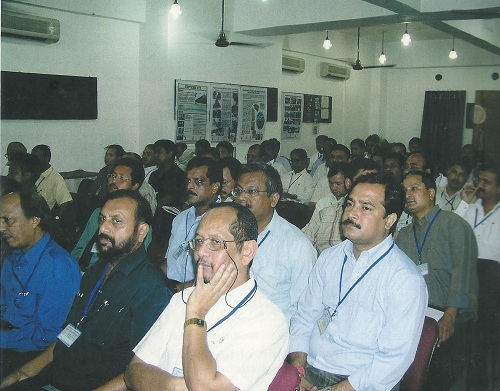
In order to address all these issues, the Cane and Bamboo Technology Centre, Guwahati organised a day long seminar at Guwahati on August 27, 2004. The meet was attended by officials of the Planning Commission, North Eastern Council, Forest Departments of the various States, Industries Departments of the various States, Members of the Federation of Indian Plywood & Penal Industries (FIPPI), Indian Plywood Industries Research and Training Institute (IPIRTI) and others.
The Seminar started with an inaugural function in which His Excellency Lt. Gen. (Retd.) Ajai Singh, the Governor of Assam and the Chairman of the North Eastern Council lit the traditional lamp and inaugurated the Seminar. The Governor in his address stated that "the people of the North¬east should take up cultivation of bamboo as a serious enterprise. Market forces must determine the demand for the supply of bamboo in the region." The inaugural meet was also attended by Dr. Kama' Taori, Secretary, North Eastern Council who laid great emphasis on the need to utilise the bamboo resources of the region. Dr. R. Mandal, Adviser, Planning Commission of India, in his introductory observation stated that "I won't call bamboo a substitute for wood as it degrades the value of bamboo, the great green treasure. After the Supreme Court imposed a ban on felling of trees in the north eastern States, almost all the plywood production units in the region have had to close down leading to large scale unemployment." Dr. Mandal stated that bamboo is much better than teak in terms of fire resistance power and water absorption efficiency; what is more, it is also termite proof. Earlier all the invited guests were felicitated and Mr. Kamesh Salam, Director, Cane and Bamboo Technology Centre, Guwahati, welcomed the participants and delivered the theme address. Mr. Salam also outlined the rationale behind the holding of the Seminar.
In the two technical sessions that followed the inaugural function, a number of presentations were made by various experts including Dr. Mandal, IPIRTI, FIPPI, banks and the like. Upon completion of the presentations, there was a session to discuss the various issues from all quarters. After a careful deliberation, the Chairman proposed to constitute a task force to make an in depth study and arrive at a logical revival package to facilitate reopening of the closed and shut down units using bamboo as the main raw material.
Overview of the discussions at the Seminar
- There should be a study on the data gathered by the Forest Working Plan and that of the Forest Survey of India and collate them in order to arrive at the actual growing stock of bamboo in each division which in turn will help designing the revival of the closed mills. This study may also include the royalty rate notified by the forest department in each state to asses the real market value of bamboo. This will help in fixing the price of mats etc. Also, the inter-state movement of N ER should be free.
- The closed mills will also have the option to produce composites of bamboo and wood. The inner fillings may be that of bamboo and the outer of wood veneer. The usage of bamboo in such composites will be more than 80 per cent. For this, opening of a Land Customs Station to import timber from Myanmar, etc. at Pangsau will immensely help the mills situated in Assam and Arunachal Pradesh. Presently, H PC has put restrictions on import of timber in NER.
- In order to avoid any complication in the future, the NEC should get a clarification from MOEF whether the three committees (H PC, SIT and C EC) constituted by the Honourable Supreme Court would have any say over the units which have converted from plywood units based on wood to plywood made from bamboo mats.
- Prior to closure of these plywood mills, most of them enjoyed the health code A-1 account in the banks for a number of years. The High Power Committee (H PC), a committee constituted by the Honourable Supreme Court, in its report had also stated that timber is deteriorating fast and immediate action to dispose off the same be taken up. In the order dated 15.01.1998 of the Honourable Supreme Court the MOEF had stated that 1.2 lac cubic metre of timber is getting deteriorated. The banks' finance was given against stock of timber and chemicals. Even though the stocks were legal, as certified by the H PC, had to be written off as it had deteriorated. Thus the value of the stock of timber, which was felled in 1996, lost all its commercial value by the time it was allowed to be consumed in 2002. The Honourable Supreme Court also directed that salary and wages be paid to all the workers and staff and none of them could be retrenched or dismissed. The companies had to incur all expenses without income, thus after paying interest for a certain period they could not pay the same as all their resources were wiped out. Thus the account with the banks became N PA without any fault of the Management. This fact was also acknowledged by the RBI in its IECD. No.13/08.12.01/2001-02 dated November 22, 2001. In the said Circular w r to all the banks, it stated "It has come to our notice that to certainextraneous circumstances, the operation of the wood and panel based industry in the North Eastern Region has been adversely affected, resulting in closure of a number of units during the last four years. Considering the importance of this industry in the North Eastern Region and with a view to enabling the industry to regain its financial health, it has been decided that banks may extend financial assistance, by way of a rehabilitation package."
In the light of these issues, the following action points are recommended:
i) A financial package may be designed for their revival.
ii) The new Industrial Policy for the North Eastern Region announced by the Government of India be plywood amended to enable the closed plywood mills to enjoy all the benefits asked for in the Industrial Policy as notified by the Government of India, vide their Notification No. Dated provided they revive using bamboo as the main raw material in line with the objectives of the National Bamboo Mission.
iii) Measures for prevention of abuse/ misuse of the proposed facility/ benefit be suggested by the task force proposed by this Seminar.
iv) The facility should also include exemption of Import Duty for new equipment required for switching over to bamboo based industry, provided those items of equipment/ tools are included in the exempted list of the Ministry of Commerce.
5. It was also decided during the discussion that the CBTC may enter into an agreement with one or two units having sound management, necessary equipment and are willing to utilise bamboo as raw material. So that the experience gained from these units could be passed on to the other closed units. These units could become commercial R&D projects.
6. That a Task Force be constituted with the following persons:
Mr. P.L. Thanga IAS (Planning Adviser, NEC) Chairman
Mr. Kamesh Salam (Director CBTC) Member Secretary
Representative of TIM PACK Industries Pvt. Limited Member
Representative of SBI Member
Representative of FIN E R Member
Mr. M.M. Jalan, Representative of FIPPI Member
Representative of MoEF Member
Representative of Forest Department, Govt. of Assam Member
Mr. H.S.Das, Finance Commissioner, Govt. of Assam Member
Mr. M.P. Agarwal, Kaziranga Wood Products P. Ltd., G uwahati
Member
Representative from Nagaland Member rhe Task Force will conduct an in depth study on the ollowing aspects related to the plywood industries of the 'eg i on:
- Probable products that could be manufactured using bamboo alone and with bamboo and wood composites.
- Source of raw material; setting up of village based clusters, etc.
- Need for renovation of the existing machineries e.g. hot press, etc. for utilising bamboo as the pressure need is higher (specific pressure is from 17 kg/ sq m to 20 kg/ sq m or more) and cost involvement in such up gradation.
- Purchase of additional machineries and their cost.
- The existing liabilities be settled and amount be fixed which be paid in ten years bearing soft interest. The FIs/ banks will have the charge on existing fixed assets.
- Legal implications for using bamboo freely to be made available both from the forest as well as non-forest areas and necessary institutional interventions.
- Policy issues like listing bamboo in the scheduled list of 18 industries under Notification Nol. 33/99 in the new industrial policy for the North Eastern Region announced by the Central Government—the possibility of declaring the revived plywood units using bamboo as the principal raw material as new industrial units under the above policy to avail of the entire fiscal and other benefits.
- Conducting a study of the Plywood cluster model in Saharanpur in Uttar Pradesh, where the Plywood and Plywood Industry have come up in large scale and again which is linked up to the plantation of fast growing timber species such as poplars, eucalyptus, etc.
- Any other relevant points for consideration.
Upon completion of the study, the Task Force will prepare a report in the form of an 'Attractive Revival Package' indicating clearly the roles to be played by the Government of India, the respective State Governments, the NEC and the entrepreneurs/ industrialists. Any financial involvement from the Government of India, the respective State Governments, etc. will have to be mentioned clearly with sufficient justification and the clear-cut benefits to be accrued upon revival of some of the units.
Mr. M.M. Jalan, Managing Director, Arunachal Plywood Industry, Arunachal Pradesh and Mr. Kamesh Salam, Director, Cane and Bamboo Technology Centre, Guwahati signed the package of revival plan.
- Log in to post comments
- Email this page