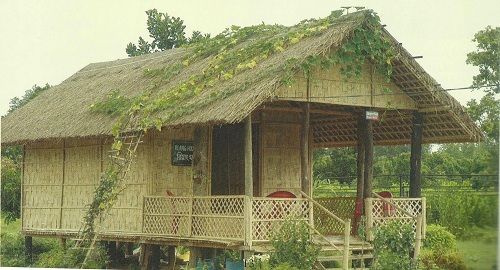
Bamboo is one of the strongest natural building materials known to man and is widely regarded as one of the most versatile grass or forest product. In countries of its natural distribution, apart from use as raw material for pulp and paper, its most extensive utilization is for construction purposes - as post, rafter, frame, partition, floor and roofing. Bamboo is not just an ideal wood substitute, it transcends wood. It comes pre-finished by nature as its culms can be used straight, without much processing.
In many places, its use is restricted almost exclusively for low cost housing, built by the owners themselves. The usage of bamboo as a building material has many socio economic benefits. Bamboo has a good tolerance to earthquakes. Plus a village community can easily grow bamboo. A small plantation of just one hectare yields enough bamboo culms each year to repair the house and also to create some products which can be sold.
Each bamboo growing country has a different kind of traditional bamboo building and the available knowledge is without any system or coherence. Attempts are being made to document these indigenous technologies. As an economic building material, bamboo's rate of productivity and cycle of annual harvest outstrips any other naturally growing resource. If three or four bamboo culms are planted, then in four or five years mature clumps will emerge, and in eight years these will be mature enough to build a comfortable, low-cost house.
Structural properties of Bamboo as a Building Material and in Comparison with other Building Materials
The cellulose in the bamboo acts as reinforcement similar to steel bars in reinforced concrete or glass fiber in fiber reinforced plastic. These fibers are concentrated nearthe outside. The stiffness (resistance against bending) that this distribution pattern creates is 10 per cent more than the one that a more even distribution pattern could offer (imagine a steel tube with high tensile steel on the outside and normal mild steel on the inside). The material between the dark spots is called "parenchyma" and it is the matrix in which the fibers are embedded (like the concrete between the steel bars). Approximately, a bamboo culm has 40 per cent fibers, 10 per cent vessels and 50 per cent parenchyma.
The density of bamboo is 700-800 kg/m' which vary with the type of bamboo. The greater the mass per volume, the denser is the material. The bending stress at failure is 0.14 times the mass per volume (in kg/m3).
Bamboo in comparison to steel, wood and aluminium
- Strong and lightweight — can be used as a replacement for steel and aluminium for scaffolding.
- Can be laminated just like wood.
- Structurally similar to steel, easy to work on and has compression properties.
- It has been verified that, because of its hollowness, bamboo's effectiveness as a beam is better than a wooden beam.
- It also costs less on a volume-to-volume basis.
- Mature bamboo culms can be harvested each year. In case of wood, one has to wait for some ten or twenty years, after which the area is cleared, with the risk of deforestation and erosion. In a bamboo plantation only the mature culms are removed, while the younger culms remain in place.
- For a floor beam or a purlin the amount of bamboo required, is only 40 per cent of the timber needed for the same purpose. Bamboo is stronger than wood in shear.
In a structural application, bamboo poles are used to create roof support systems.A typical rooof support system will have a truss and can be covered with a rafter and pulin network for the roofting sheets.
Bamboo - Structural Components
Roof: Corrugated bamboo roofing sheet is being developed at Indian Plywood Research and Training Institute) IPIRTI, Bangalore, India. It is made from woven bamboo mats.
Walls: Woven bamboo mats are used to make walls in countries such as Bangladesh and India. Vertical whole or halved culms and flattened tmboo strips are also used for making walls. Walls can be made with bamboo as a minor component and mud as a major one (bahareque) as well.
Doors and windows: Bamboo can be fashioned artistically to make doors and windows.
Floors: Floors can be made out of flattened bamboo, woven bamboo mats or split bamboo.
The houses made by the National Bamboo project in Costa Rica are example of an good design; over hanging roof a structure of Bamboo Culms, Walls of panels of split Bamboo with cement morter on both sides, and ventillation through the upper part of the walls.
It is a wattle and daub technique that normally uses timber poles for the walls structural frames. A double layer of horizontal bamboo split is use as as supporting surface of the mortar, which is plastered on both the outer faces. This result in a very effective structural components.
With the infusion of new techniques to create the various component of a structures,we are now able to look ahead and suggest the increasing use of Bamboo to create low cost housing ,Innovation Resort and Hotel structures prefabricated structures, pavilion etc.
With proper treatment, good design practice and skill workman, it is possible to create standards in Bamboo construction which will appeal to wider section of the society .
- Log in to post comments
- Email this page