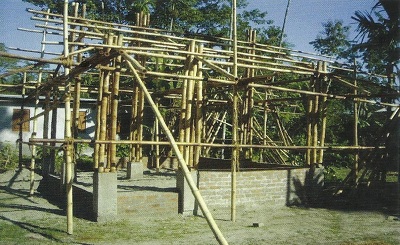
Bamboo Building Essentials
Plant the Hardest Species for the Climate
When growing bamboo species for building, choose varieties with thicker walls, as well as a cold tolerance that relates to your area - the key is to plant a species that is capable of withstanding the coldest seasonal temperatures. Refrain from using fertilizer on the bamboo, in particular nitrogen, which leads to rapid growth and weaker poles.
The current international building code tested strength of a species from a single place and time as applicable forthe entire species, regardless of growing conditions. Several builders have put forth the "unproven" idea that the density of the wood is a better measure of how soil, rainfall, care and age have all had their effect - regardless of species. Unfortunately, there are currently no grading or quality standards for bamboc poles. This means that the purchase of poles involves a great deal of faith and relationship-building betweer buyer and grower.
Different species are chosen for import into the U.S because of a unique visual characteristic like striped leaves or colored culms. For builders, the moss intriguing species are seen by others as "just another green bamboo." But imagine what we consider the holy grail of bamboos: in the tropical latitudes of the Himalayas, over thousands of years, plants have been forced to adapt to the rise of the mountains to very high elevations. So, the unique combination of a clumping, cold-tolerant, large diameter with strong fiber and tremendous pole production when grown in a more favorable climate might exist.
Plant where there is Plenty of Water and Sun
Bamboo requires plenty of water year round, as well as an abundance of sunshine. For this reason, bamboo is seen growing wild in ravines and along the banks of rivers and in places with a Monsoon hot-season climate: tropical Southeast Asia, the temperate foothills of the Himalayas, and the tropical northern half of South America primarily.
In places where there is less rain (i.e. southern California), wastewater is a good water source. The dense feeder roots make great filters and bamboo is capable of handling and using much hotter sources of nitrogen than most plants. Moso bamboo, for example, seems not to thrive unless watered every day.
By
Darrel DeBoer, Architect
Megan Groth, University of Washingtor,
- Log in to post comments
- Email this page