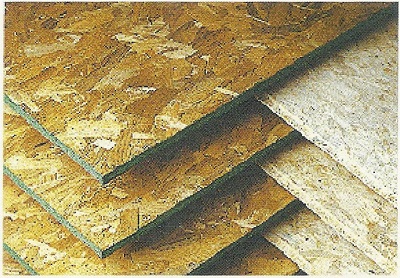
Particle boards were first made around the time of World War II as there was a shortage of timber in Europe. They were widely used because the process enabled wood particles from relatively useless small and low grade timber to be transformed into useful large wooden panels. A product called wafer-board appeared in the market in the 1970's. It consisted of a random array of thin flakes about 50 mm both in length and width. The Oriented Strand Board (OSB) industry evolved from the wafer-board industry in the late 1970's as technology and investors caught up with this concept. From the time of its invention, research has been conducted into the effect of chip size, the raw material used, the three layer structure, the different methods of strand alignment and the effects of the alignment itself on the strength of OSB. The result has been the development of the commercial OSB produced by the industry today.
Why is OSB so special?
OSB is three times as strong as particle boards of the same density and resin content. Its three ply form has been described as comparable with Douglas fir plywood. It is an improvement over wafer board as it has its flakes, or strands, aligned. This alignment can take place because the strands are not dimensionally uniform, being only a third to a half of the width of those of wafer-board though approximately of the same length. The core flakes are aligned at right angles to surface layers. This is intended to mimic the structure, and consequently the strength properties of plywood. In other words OSB was introduced as an attempt to compete with plywood as a structural material while using a Low quality resource.
Bamboo Wafer Boards
Bamboo has many superior qualities compared to common wood and thus its processed products are also superior in specifications and has the potential to replace related wood based products. Many engineered bamboo products have been developed till date and are proving to be promising in terms of quality and price.
After long years of R & D, scientists and engineers have come up with a bamboo product called Bamboo Wafer Board (BWB). While manufacturing BWB, the yield of bamboo is very high and the glue consumption is also lower. As, glue is the main cost component in any bamboo board unit and next is the bamboo itself, the low consumption of glue and high yield of bamboo makes this BWB very cheap compared to those boards without compromising on quality. Unlike for wood, to obtain better quality specifications, one needs to produce OSB. But, for bamboo OSB is not at all necessary since BWB is quite strong, thereby keeping the project cost low.
BWB is one of the excellent engineering structural panels for interior and exterior applications. BWB has outstanding performances in load bearing strength under humid conditions, besides being termite and decay resistant, weather enduring, etc. BWB can be used as a replacement of wood based WB or OSB for various purposes both indoors and outdoors. BWB can also be covered with wood veneer, bamboo mat or plastic sheet or impregnated paper for super structures and vehicle floor.
The thickness of BWB can be made from 4 mm to 25 mm or more and size of 1220 X 2440 mm. Non standard sizes can also be made on request. Further, the density of BWB can be adjusted as per the requirement of the customer.
In conclusion, it can be said that BWB is an excellent substitute for wood based particle and wafer boards and OSB and at the same time, cost-effective.
- Log in to post comments
- Email this page