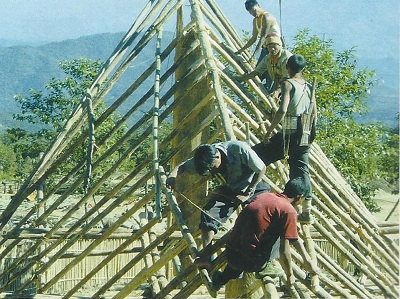
The history of genus Bambusa or Bamboo is not only rich, but also warrants a promising future for humanity. It has benefited human societies since times immemorial, and continues to be a tremendous asset to billions of people around the world. Bamboo is a fast-growing widespread, renewable, versatile, low-or no-cost, environment-enhancing resource with the potential to improve life in the years to come, in both the rural and urban areas of the developed and developing world.
As global population grows and resources stretch, bamboo holds the potential to benefit the poor, with its vast spectrum of utilisation, ranging from providing shelter and piping to agricultural tools and furniture. Furthermore, apart from its traditional usage, bamboo has various new applications as an alternative to rapidly depleting wood resources, and as an option to more expensive materials.
This paper reviews the use of bamboo over time outlines the nature and properties of the plant and takes into consideration its particular importance for women. It then looks into some of the institutions working to promote greater use of bamboo, and the challenges this valuable resource faces to realise its full potential.
Bamboo and people
Archaeological evidence demonstrates that the bamboo has been in use for at least 6000-7000 years, and has played an important economic and cultural role in the development of human societies especially in those regions of the world where it has been a dominant component of the vegetation. It has been variously described as the 'wood of the poor' (India), the 'friend of the people' (China), and the 'brother' (Vietnam). Bamboo is an amazing plant that grows over wide areas of Africa, Asia, the Caribbean and Latin America. Today, millions of people continue to depend on the bamboo for food, fuel, housing, scaffolding, agricultural tools, cooking vessels, water jugs, arts and crafts, furniture, weapons, hunting gear, musical instruments, and the list goes on. Deeply entwined in cultures and heritage of people around the world, this versatile plant has come to symbolise strength, tenacity, endurance, and compromise. Bamboo seeds and protein-rich culms (shoots) are popular food item thr'oughout Asia, and power a billion-dollar export industry in China, Taiwan-China, Japan and many Southeast Asian countries. The leaves and culms are often used in Asian baking and cooking, while bamboo is the food of choice of pandas, elephants and guinea pigs.
The medicinal properties of bamboo have been well, known since ancient times and documented in the ancient Hindu system of medicine, Ayurveda (1500 B.C.), in Chinese scriptures and in Latin American literature. Various parts of bamboo leafs, rhizomes, roots and culms, as well as the charcoal made from its wood, have been used to treat a number of ailments such as cough, bile, fever, leprosy, swelling, cuts and wounds; it is also used as a laxative, bladder purifier and antidote for impotency and frigidity.
Bamboo has been, and continues to be widely used around the world to make spears, knives, arrows, blowguns, darts, fishing rods and harpoons. Some communities still rely on bamboo knives to sever the umbilical cord and to perform circumcision. In Thailand, bamboo knives are used to cut the thin gold paper that is used for offerings in Buddhist temples. Bamboo rafts have been commonly used for coastal commerce. The use of bamboo as a fuel source (capable of generating 4000-6000 cal/g) for households and small industries is an age-old, continuing practice.
Since time immemorial, bamboo has played an important role in the development of percussion, wind, and string musical instruments; the flute being the most popular of them all. Flute-making is a specialised art catering to a multi-million dollar market, and produces designs from the simplest to the most sophisticated. References to the flute are found in the scriptures, myths, chronicles and legends of culture around the world. In the Hindu tradition, Lord Krishna, one of Vishnu's incarnations is depicted in all forms with a flute.
Bamboo has also been a prime material for creating a wide array of household articles — baskets, utensils, lamps, furniture and art works. In China, bamboo weaving dates back to the Neolithic Age, and showed the highest sophistication and ingenuity as it evolved and broadened from producing articles of daily use to creating handicrafts and works of art for value-added commerce.
Tracing the linkage between bamboo and human development requires recognizing the leading role long played by China and to a lesser extent other Asian countries, such as Japan, India, Thailand and the Philippines. Asian history has cherished bamboo, heaping praise on its excellent attributes, and considered as integral to survival. It has been depicted. In poems, paintings, and music; and continues to form a vital element in the art of landscape gardening.
The use of bamboo reached its pinnacle in China long before the Industrial Revolution in the West. The ancient Chinese classics were written on bamboo slates, and when the Chinese invented paper in the 9th century, it was made of bamboo. Even today, Chinese companies dominate the global bamboo trade with their fine quality crafts, a variety of industrial products, and works of art.
In India, theancient scripture, Rig Veda (1500 B.C.), often refers to the art of archery with bamboo as the favoured material for bows and arrows. In his famous Arthasastra (The Art of State Craft), Kautilya (322-298 B.C.), the prime minister to the first Maurya King refers to the lucrative bamboo trade as a major source of state revenue.
Africa offers similar stories about the use of bamboo for fuel, construction and household items, although the recorded history is more recent. In both Latin America and Africa there has been little or no recognition of bamboo's socioeconomic potential for community development or national economies. However, largely through support of the United Nations Development Programme (UNDP), the United Nations Industrial Development Organisation (UNIDO), the Food and Agriculture Organisation (FAO), the International Timber Trade Organisation (ITTO), the International Development Research Centre (IDRC) and the International Network for Bamboo and Rattan. (INBAR), the last decade witnessed a renewed awareness of bamboo and a resurgence of its use, mostly for large-scale, low-cost housing.
In the West, the first mention of bamboo is found in a letter from Alexander the Great to Aristotle referred to by Pliny the Elder (23-79 A.D.) in his book on Natural History. The first high-tech application of bamboo in the West came in 1880, when Thomas Edison used a filament of bamboo carbon in his electric light bulb. At about the same time the Forest Research Institute in India pioneered industrial research for the commercial prdduction of paper from bamboo. This resulted in producing a variety of paper and pulp, including bleached and dissolved pulp for viscose and rayon and paved the way for development of the country's industry.
A giant, woody grass
Bamboo is a product of the tropical forests — a tree like, woody grass, distantly related to wheat, with some 1250 species in 75 genera. It likely appeared 200 million years ago, during the Triassic Period, the era of the dinosaurs. Covering vast expanses of land (about 25 million hectares) it now grows in the tropical, subtropical and temperate zones of all regions of the world except Europe and western Asia.
Bamboo's distribution ranges from 51°N (Sakhalin Island) to 47°S (Southern Argentina), and altitudes from near sea level to elevations of 4000m. South America and Southeast Asia are the centres of diversity. In Asia, bamboo is most abundant and diverse along the southern and south eastern borders. Africa has far fewer species (though Madagascar is rich with endemic genera); Australia has four indigenous species and the United States only one (prevalent across the country's southeast and mid west before European colonisation).Recent findings reveal that bamboo grew in Europe some three million years ago. It vanished during the last ice age, and was reintroduced about 200 years ago, mainly for horticultural purposes. A wide range of varieties and types have since been developed, with some tolerant to temperatures as low as -25°C.
Most bamboo culms live for up to 20-30 years. Some live for more than a century. The plant is a self-renewing resource, with fast-growing culms sprouting every year which more than replace those that have died or have been harvested. Although bamboo found in the natural forest is important for its quantity and diversity, the plant is grown in many parts of the world around villages and homesteads alongside food and other crops, owned or managed by local people. Large plantations have also been established by both the public and private sectors in Asia (over four million hectares in China), Latin America (Brazil, Costa Rica, Cuba, and Mexico), and even in the United States.
Bamboo is the world's fastest and strongest growing woody plant. It grows approximately 7.5 to 40 cm a day, with the world record being 1.2 m in 24 hours in Japan. Bamboo grows three times faster than most species of eucalyptus and can be harvested four times as often. Commercially important species of bamboo usually mature in four or five years, after which time multiple harvests are possible every second year, for up to 120 years in some species, and indefinitely in others. Bamboo also excels in biomass production, giving 40 tonnes or more per hectare annually in managed stands. It accounts for around one-quarter of biomass produced in tropical regions and one-fifth of that produced in subtropical lands.
Bamboo's foliage shelters topsoil from the onslaught of tropical downpours, while its leaf litter (up to 10 cm a year) also cushions the soil from the impact of rain and eases the
soil's absorption and retention of moisture. Bamboo preserves many exposed areas, providing micro-climates for forest regeneration and watershed protection (the plant's vast underground rhizome network may cover up to 100 square metres around one bamboo clump). It is often introduced to the banks of streams or in other vulnerable areas, for rapid control of soil erosion; one bamboo plant's closely matted roots can bind up to six cubic metres of soil.Properties and use
Bamboo, 'the miracle plant', benefits approximately half the world's population, used as a commercial commodity and subsistence. It is known to be hardy, light and flexible, and sought for its nutritional and environmental value. It has more than 1500 documented applications, ranging from medicine to poison, and from toys to aircraft. Bamboo's many varieties and characteristics have helped humans in seemingly endless ways.
The culm, the most economically important part of the plant, can grow to more than 40 m in just three to four months in some species, and one can literally watch it grow. In 35 years a bamboo plant can produce some 15 km of usable pole, of up to 30 cm diameter. The annual global crop of bamboo is estimated to be ten million tonnes, or approximately eight million km, enough to girdle the earth 200 times.
Since ancient times, Asians have relied on bamboo roots, leaves, sap and ash to remedy minor and major ailments, particularly in traditional Indian and Chinese health care. Tabasheer, a silica containing substance found in the culms of many species of bamboo, is used in medicine and as a catalyst for certain chemicals. Current research is further exploring bamboo's medicinal potentials.
Bamboo also provides people a healthier environment, in many different ways. Besides sequestering carbon, and easing the impact of tropical rains, it also lowers light intensity and offers protection against ultraviolet rays. A pioneering plant (which provided the first re-greening of Hiroshima), it provides the fastest-growing canopy possible for degraded lands, creating micro-climates for other life and yielding more oxygen than equivalent stands of trees. A bamboo forest can even be part of a natural environmental cleansing system that converts pollution into plant nutrients while producing valuable crops. Bamboo finds many commercial uses in such fields as the rayon, handloom, fishing and sericulture industries. It provides millions of jobs and supports key economic sectors:
- in China alone, bamboo industries generate more than US $ two billion annually;
- India, bamboo is used in the US $ 400 million incense stick industry;
- Bamboo-related activities in India generate about 432 million workdays and US $ 600 million in wages annually (Adkoli, 1996 from Bamboo, People and the Environment);
- in Thailand and other Asian countries, it is used as ar important raw material for industries.
Bamboo has multiple economic possibilities, important ecological value, and enormous ability to meet the needs of people and industries (especially those in rural areas)_ Unfortunately, far too little attention has been paid, up to now, to the management of natural bamboo stands and to ensuring that there will be a sustainable supply of this raw material in the future. This results in constraining and reduces the potential benefits and value of bamboo use. Related development issues, problems and prospects, are identifiable in three areas of focus;
- Resource mobilisation and improved management, technologies and processing techniques (valued by customers, knowledge-based and accepted globally);
- Policy interventions to ensure a sustained supply of bamboo and to elevate bamboo to the mainstream as a viable substitute for (tropical) timber;
- Education, public awareness and international cooperation.
Women and bamboo
Despite conscious national policies to reduce gender disparities, women continue to have less access to better paying jobs. In fact, according to U ND P World Development Report, in no society do women enjoy the same opportunities as men and are disproportionately represented among low-paying jobs or work in the informal sector. Althougconsiderable progress in developing women's capabilities has been achieved their participation in the labour market remains very limited.
The bamboo sector though not a high-profile sector, has provided women opportunities to participate in the labour force. In most countries where bamboo grows and is used, women form a major part of the work force. In China up to 70 per cent of workers in bamboo-processing factories are women, as are about 80 per cent of the workers in Vietnam's home-based bamboo enterprises. In India women make up the majority of mat-weavers and makers of incense sticks. The flexibility of scheduling such activities enables women to contribute to their household income.
Challenges .
Despite bamboo's economic potential, its ecological benefits, and its relevance for poverty alleviation, the resources base has been under managed and is commonly overexploited, especially in Asia. This results in the harvesting of mediocre material, inadequate efforts to regenerate depleted areas, and the generally unsuitable management of natural stands. A first step to correct this situation would be to undertake an inventory of the extent and distribution of existing bamboo resources (at the regional, national and global level) to allow for sound planning in bamboo dependent industries.
A second challenge to the realization of bamboo's socioeconomic potential is the developmental imbalance that exists in the industrial use of this resource. The fast-growing bamboo trade, in both domestic and export markets, create heavy competition among bamboo producing countries. While some nations (and provinces) have achieved remarkable results, other resource-rich countries are lagging behind in bamboo development. In addition, standards and quality control need to be developed, while certain technologies require major refinements; such as, improved processing techniques with an emphasis on creating greater durability and a better finish.
There is an urgent need to modernise both the design of bamboo products and their use. Where bamboo was once favoured, plastic and metals are often being sustained because they are uniform, cheap, durable and readily available. The challenge is to analyse customer needs and to identify commercial opportunities (i.e. market segments, end users, product types such as ply-boo). At the national level, there is clear need for coordination and organisation among the various sub-sectors, so that action plans can be created for development of the bamboo industry. In other words, bamboo must be put on the development agenda.
Yet another major challenge is the need for public education campaigns, as well as training at different levels, to correct the popular perception of bamboo as an antiquated material, unable to compete with more 'modern' alternatives. With new technical inputs and innovative marketing, renewed interest can be generated; bamboo's image can be changed from that of the 'poor-man's timber' into achieving its appropriate status as a material of the future.
Given the small-to-medium size of the industry, few standards exist for most products made from bamboo. Among the few exceptions there are the national standards adopted in China and India for certain panel products. The development of codes and standards is essential for growth of the bamboo industry and acceptance of bamboo as being at par with timber and other construction materials.
Past, Present, Future
Used for millennia for a wide range of day-to-day purposes, both as a woody material and as food, bamboo has been the backbone of much of the world's rural life and will remain so as populations increase. Bamboo will continue to play an important part in the development of enterprises and the transformation of rural environments in all the regions of the developing world where it grows.
In many parts of rural Asia, and for indigenous forest communities, 'bamboo for living' and 'living with bamboo' is still the norm, and this plant-of-1500-uses offers an excellent entry point for rural poverty alleviation. Bamboo can also provide a valuable model for the sustainable development of other non-timber forest products and benefit women and other underprivileged people.
Bamboo is thus not a material of times past, but one that has countless and growing uses today, even in the industrialised countries. It also has renewed prospects for enriching human development, and holds the potential
·
For improvement of rural communities;
·
For the sustainable development of the environment;
·
In the production of industrial products;
·
As a 215t century alternative to timber.
Green markets are growing, and offer new opportunities for the promotion of bamboo as an alternative to wood. All stakeholders have a major responsibility to promote bamboo's environmental image as a genuine timber substitute. Bamboo is highly versatile, lending itself to distinct and unique furniture designs, to new-generation building materials, and to a vast range of items, thereby generating countless jobs.
Widespread and adaptable to different climates, user-friendly and accessible, ecologically virtuous, bamboo has major, under-realised potential to benefit the social and economic development, and strengthen the autonomy, of enormous numbers of people, especially those living in countless rural communities. The 'miracle plant' can have a strong, positive impact in coming decades on many aspects of human development.
Contributed by Dr. Cherla Sastry Former DG, INBAR
- Log in to post comments
- Email this page